Autumn Gear Guide
Find inspiration in our Gear Guide that will keep you out on your bike through wind or rain.
Download Now
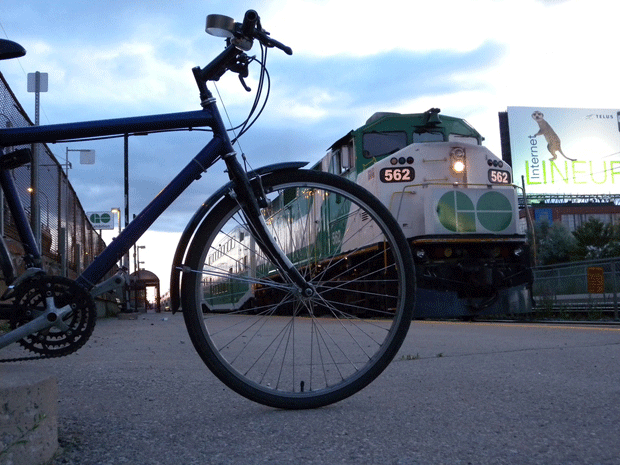
Here are a few tips to help make your multi-modal commute, by bike and transit, a hassle-free experience.

Often, the quickest way to get somewhere in the city requires using more than one form of transportation. If your trip is longer, combining bicycling with other forms of transit is a great option. Here are a few things you can do to make your multi-modal commute a hassle-free experience.
Research Transit Regulations in Your Area
Check out your regional transit website. Not only can you look up bus, train and subway schedules, but you can find cycle specific transit information for your city. For instance, some cities permit bikes to travel on trains at any time, while some prohibit bikes from boarding during peak hours. To find out what regulations you need to be aware of, consult your city’s transit website.
Get a Map
A transit specific map, preferably one that incorporates bike routes as well as transit stations, will take the headache out of trip planning on-the-go. You can usually find maps at transit kiosks, or view the digital version on your regional transit website from your smart phone. Making route choices while you navigate from home, work or school to a transit station and continue on by bike to your end destination is simplified when you have a reliable map in front of you.
To Lock or Lug?
Most transit stations have a designated place to lock up. Some even have bike storage lockers (usually monthly rentals) to ensure your bike is safe while you commute. If you are lucky enough to live in Long Beach, Washington, DC or another center with a Bikestation, take advantage of secure 24/7 bike parking and self-repair stations. Wherever you leave your bike, remember to securely lock your wheels and bike frame, and remove all easy-to-steal accessories, such as bike lights or an expensive saddle.
If you can’t find secure bike parking, don’t feel confident leaving your bike locked to a rack or need to use your bike in a later stage of your commute, you can often take your bike on transit. Cities are making it easier and easier for commuters to travel with their bikes: many busses have front racks, and some train cars have designated bike areas where cyclists are provided with extra space.
Loading your bike on the front rack of a bus may seem daunting, but it is really quite easy. Check out this video to see how it’s done. Detailed rack loading directions can usually be found on your local transit website, and if you are still uncertain, just ask the bus driver – they’re usually happy to help first timers.
Carry Your Stuff
Whether you lock up your bike or bring it along for the ride, how to carry personal items is something worthy of consideration. I avoid using a backpack, because they hurt my shoulders and leave the back of my shirt a hot sweaty mess. Panniers, or a messenger bag, make carrying stuff easier. If you opt for panniers, look for models with easy-to-grip handles, or an extendable shoulder strap – because there’s nothing worse than parking your bike and dragging around an unwieldy, heavy bag for the rest of the day.
Maneuver Your Bike Safely
If you bring your bike on transit, be prepared to pass through crowded corridors of people. Be aware of your bike’s dimensions, and you will be able to maneuver your bicycle with confidence and courtesy. At some point you will probably have to pick your bike up and carry it over a curb or down a few stairs. I find it easiest to lift my bike by holding the handlebar stem with one hand, and gripping a low point of the frame with the other.
Be careful not to block entrances or exits. Hold your bike steady to keep it from rolling, and be prepared to shuffle back and forth if other commuters need to get by.
Keep in mind that bikes are not permitted on escalators, so it is a good idea to familiarize yourself with the location of elevators if you commute through a station with multiple floors. If you have real difficulty moving your bike around, or commute during rush hours, consider a folding bike.
Add Bike Share to the Mix
While not available in all cities, the rapid expansion of bike share systems is a great way to incorporate cycling as part of your commute. Often, bike share systems are located near train and transit stops, so the transition can be effortless. They also save you the worry of leaving your own bicycle locked up at a station, especially if bike parking is scarce or not secure.
 Top 10 Tips for First-Time Bicycle Commuters
 The Best Community in America for Bike Commuting
 How to Ride on the Road
 The US Senate Releases the “DRIVE” Transportation Bill
 Buddy Bike Celebrates 10 Year Anniversary
 Dahon EEZZ D3 Folding Bike Review
 Belt Drives: How They Work
 The Bike Rave – A Game Changer (With Glowsticks)
Find inspiration in our Gear Guide that will keep you out on your bike through wind or rain.
Download Now


Leave a comment