Autumn Gear Guide
Find inspiration in our Gear Guide that will keep you out on your bike through wind or rain.
Download Now
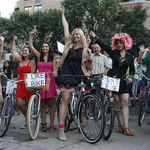
Women want to cycle, but the barriers are real: lack of safe cycling infrastructure, economic barriers to buying and maintaining a bike and cultural norms that dictate what’s feminine and what’s not.

By Anna Bowen
Female urban cyclists are as diverse as the bikes they ride. When a friend of mine recently rolled up to my back porch in Toronto, ON, on a black Norco Emma city bike, all decked out in business attire and a tweed helmet, it wasn’t just her style that impressed me. Rachel Percy, policy analyst for the Government of Ontario, used to think cycling in Toronto was only for diehards. Her limited experiences of cycling left her in the dust: “I fell off my bike and I wasn’t even riding it!” she said of her experience at a stoplight near an intimidating overpass in Toronto back in 2004. She now bikes to work — four miles (seven kilometers) each way — on every “good weather” day.
From blogger moms taking their kids to school on a bike bus, to Latina teenagers riding fixies in LA, women want to cycle. But the barriers to bicycling are real: lack of safe cycling infrastructure, economic barriers to buying and maintaining a bike and cultural norms that dictate what’s feminine and what’s not are all challenges that women can face when they consider cruising on two wheels. Added to that are the social pressures that can make women feel uncomfortable in a mainstream bike shop and the fact that they often cannot find the functional and fashionable everyday cycling clothes and accessories they’re looking for.
The Gender Gap
In the last decade, more men have been hitting the pedals than women. The percentage of bike trips made by women in the US fell five percent between 2001 and 2009, according to a report by John Pucher, a professor of planning and transportation at Rutgers University. Men accounted for about three-quarters of all bike trips made in the US in 2009. That’s discouraging news, considering that women have been called the “indicator species” of the overall bike-friendliness of a region, as the more of them there are, the more widespread cycling seems to be. In the Netherlands, where the cycling mode share is around 27 percent, women account for 55 percent of the cyclists on the street, and 49 percent of the total population.
Allison Mannos, urban strategy director for the Los Angeles County Bicycle Coalition, works with Latino immigrant day-labor cyclists in LA, where she said pretty much everyone she works with is male. ìItís framed as a very male thingî to use a bike for transportation in low-income immigrant communities, she explained. In her community, women generally reserve bikes for recreational use. “There aren’t enough affordable bike shops within their neighborhoods,” she said, adding that, in LA, it is very clear that immigrant women take the bus.
Empowerment through DIY Repairs
Portland’s success over the past 15 years or so is credited in part to women-only bike repair times and women’s group rides. Many of the women I spoke to confirmed this, citing DIY, women-only repair times and group rides among the motivators for getting them up and rolling.
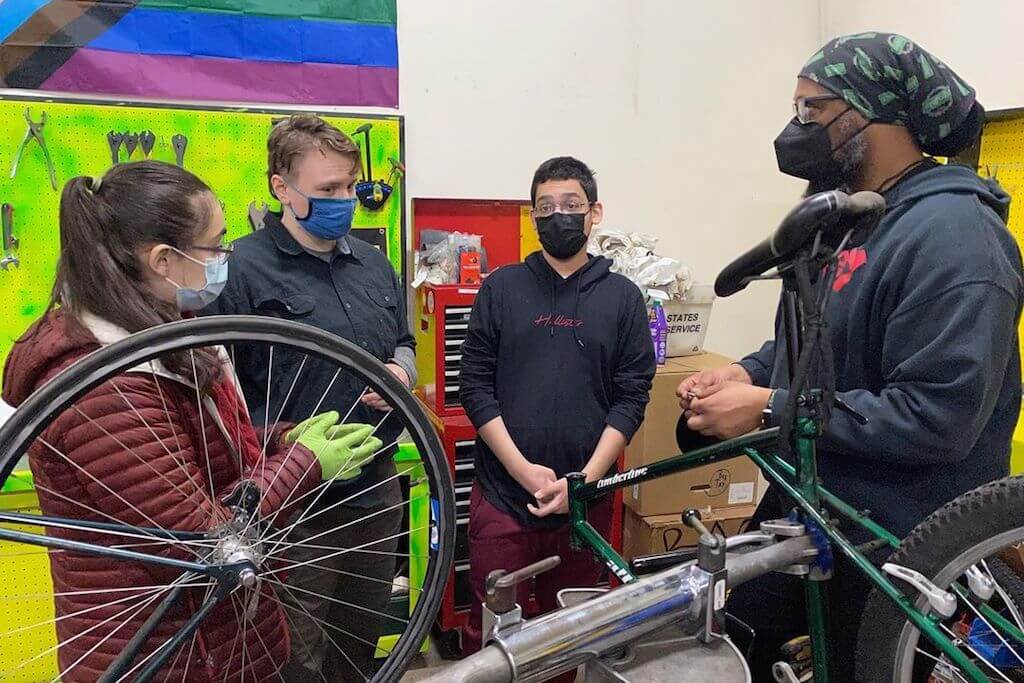
“Bikes need to be demystified,” said Ainsley Naylor of Toronto’s Bike Pirates, a nonprofit DIY bicycle collective. Naylor coordinates women- and trans-only repair times once a week at Bike Pirates. “We definitely see a lot of women who are just overwhelmed by trying to buy a bike, or leaving their bike to rust because it got a flat tire and they didn’t know what to do.” Percy said of her first bike shop experience: “I wasn’t intimidated because I was a woman, but I was intimidated because I didn’t know anything about bikes.”
This could explain the allure of bike share for many women. Bike rental programs in Mexico and Minneapolis have a higher percentage of female patrons than the average number of female cyclists in those regions, and the prospect of using a ride-ready, maintenance-free, hassle-free mode of transportation could be why.
Playing it Safe
Research has shown that women in general tend to be more risk-averse than men, said Janine Hegeman, ride committee chair for the Colorado Springs Cycling Club. “Safety is a very big issue. There are many gaps in the trail system (that) are discouraging to newer riders.” Said Samantha Arnold of Chicago: “We need more bike lanes that are suitable for taking our children in – I’ll ride a cargo bike if I can get separated bike lanes.” A lack of secure places to lock a cargo bike doesn’t help, either, said Arnold.
The Association of Pedestrian and Bicycle Professionals (APBP) published a Women’s Cycling Survey in 2010, which members Fionnuala Quinn and Andrea Garland played a large part in bringing together. The survey gathered input from over 13,000 women across North America. “Supporting better quality bicycling facilities in our communities will increase the number of women who will be willing to try cycling, leading to the potential for equalizing usage,” said Quinn. When she moved to Philadelphia, she explained, “as a civil engineer it became increasingly clear to me how big a role infrastructure design played in limiting my cycling options as well as in safety problems created for cyclists by the built environment.”
Interestingly, the APBP study found that some women actually cycle for safety reasons, saying that it is safer than walking or taking transit in urban centers at night. Naylor of Bike Pirates, for instance said that “as a woman, I have always felt safer riding my bike, especially alone and after dark.”
Many cycling organizations are finding that cycling in groups is a good way to bolster confidence. Mannos, for instance, said that the “Ovarian Cyclist” rides have been really empowering. Felicia Williams, board member of C.I.C.L.E. in Pasadena, CA, also commented that their Ladies Night ride has been helpful to first time riders who are scared “about riding in traffic or of being left behind by their male counterparts.”
Bikes vs. Fashion
Maybe it bolsters the status quo, but a lot of women are not excited about getting to work sweaty and grease-stained. Euro-style bikes that protect skirts and cuffs with chainguards and internal gears, and fashionable duds made specifically for sitting pretty, do have a niche market when it comes to female urban professional cyclists. Teresa Delfin, founder and CEO of Mountain Mama clothes in California, said, “Performance is at the top of my list, but as someone who has been known to wear a little black dress over a pair of Castelli bib shorts, I won’t pretend that style is a non-issue.”
Hegeman said that very few women at her club participate in fitness rides to avoid getting sweaty or looking “slow in front of all the guys.”
“Inconvenience factors, such as weather, sweat, helmet-hair and appropriate clothing may discourage some women from cycling more often or at all,” said Garland of the APBP survey.
Kim Burgas, an NYC designer and cyclist who organizes “Get Fancy” gallery-hops by bicycle, has one solution: “I would love a few spots around the city where I could change, freshen up and shower after commuting.” Likewise, Arnold, who is an adaptive bike advocate and blogger, said “the fact that I don’t need special clothes, don’t have to worry about grease on my pants or mud on my clothes with a Dutch bike is huge. I can ride everywhere and still look nice.”
But riding in heels isn’t everyone’s concern. The current trend in LA is for teenage girls to ride fixed-gear bikes, said Mannos. “Among low-income teenaged female cyclists, the fashion is the bike, the trend is having the fixed-gear,” she said, and not so much the clothes.
The concern with fashion depends on the expectations at your job and your sense of style to begin with. Sara Armstrong, blogger and cycling mother of three in New Haven, CT, said, for instance, “style matters very little to me; it’s more about utility.” Although she appreciates new cycling fashion, she said: “I just was never a chic woman to begin with!”
Gotta Have Time?
Elly Blue, an independent writer in of Portland, OR, clearly laid out the barriers that women face when it comes to cycling: “Statistically, we have more errands to run, more child and elder care duties, less leisure time, and even though we make less money than men in similar jobs, we are expected to meet a higher standard for professional appearance and behavior in order to get and keep those jobs.”
Whether it is riding to the law office, schlepping kids to school, racing, touring or picking up groceries in the snow, what women want is to ride. And with a plethora of bike blogs that address gender and cycling, such as Velojoy, Taking the Lane and Full Hands, it’s clear that gender is still a hot button issue in the cycling world.
If cycling is often the most economical and efficient way to get around in North American cities, and women aren’t biking because they don’t have the money or the time, there has to have been a disconnect somewhere that needs mending. Some female cyclists, such as Janine Hegeman, are crunching numbers and finding out that cycling really can make sense as part of a busy lifestyle. But because our society is set up for cars, cycling doesn’t always seem like the natural choice. More public education and encouragement for women is key for both female cyclists and the environment. As the number of riders across the continent increases, let’s not allow women to be left behind.
The good news is that all over North America, women are organizing and advocating for accessibility to cycling. Women- and trans-only bike repair times at bike shops, better and safer ways to transport kids, community bike rides that reclaim the roads and, of course, cutting-edge, functional cycle fashion are all increasing women’s comfort on the road.
Anna Bowen is a freelance writer in Toronto, ON. Her articles also appear in Spacing, Geez and Alternatives Journal. Things she has towed with a bike trailer include: a writing desk, her toddler and a canoe.
Find inspiration in our Gear Guide that will keep you out on your bike through wind or rain.
Download Now

I am sad to agree with “tiresome” above (or below?). Safety issues and most other obstacles are what they are, regardless of gender. It also concerns me when I see articles referring to safe routes/infrastructure being an issue, when the pictures that go along with the article mostly depict women without HELMETS. ???
I HAVE ridden in evening gowns, and typically ride everyday in skirts and dresses. Nearly 10 years car-free in Los Angeles. (yeah!!) and not that much of a girly girl…but for some reason I don’t own pants. Reasonably narrow skirts and dresses with BACK vents or slits don’t usually cause any problems with getting caught up in my chain. Those with SIDE slits or lots of fabric DO. My tip: keep a couple of medium- or large-size binder clips on hand and use them to gather up and secure swaths of fabric that could get caught. [Clip ’em on your brake cables while you’re in the meeting or wedding reception.]
Cycling was and is the great social liberator. To read this piece and how hard it is to be a women in a cycling world is dreadful. How hard can it be to look at a video of Amesterdam look at the bikes go find one on the Internet and buy it. Or look in the papers second hand and buy it. You don’t need special clothes the clothes in your closet are fine. It’s never been easier to get on a bike. Is this what women have become in the modern world afraid to walk into a bike shop.
Wow. I think this article is great. …And for the record, I’m a woman who’s worked in construction, landscaping and in the cycling industry, so I don’t believe that there’s a ‘boys club’ or any thing like that There is, however, an ‘opportunities club’ a ‘labor gap club’, a ‘wage gap club’ and a few other related ‘clubs’ that play a part in preventing women from feeling welcome, qualified, accepted, or able to participate in certain areas of our society. And specifically speaking, I think there *are* real world barriers to cycling that women face. Barriers that men do not- certainly some of which are related to expectations, social norms, etc…. but I do think that they are surmountable, regardless of their nature.
(As for riding in an evening gown- I’ve found that it’s really hard to do and a little bit dangerous.)
agree that this was confusing/annoying/patronizing. a lot of people are nervous about riding, don’t want to get dirty on their way to work, or don’t think about it because our social norms are not built around it. it is not a “woman” thing. I’d like to feel safe taking my 80-year old dad out for a ride or my 12-year-old nieces. I’d like better bicycle parking around public transportation, as well as access to more trains and buses, and I’d like fewer potholes and better lane markings. none of this is related to my gender.
There is a gender gap in cycling because women don’t like to ride as much as men do. That goes for pretty much everything else that is done disproportionately more by men: they just like it more. Most women I know rarely do anything physical at all. My mom, sister, grandmothers, cousins, etc. rarely hike, bike, run, or do much of anything physical. Even my female friends, some do physical stuff, but most do not. Men are too busy actually doing things to worry about a “boys club” on the street.
I have – not to mention in office-appropriate clothing every day for about 8 years – and the thing is, women on bikes get a lot of harassment, which just about doubles if you wear a skirt instead of pants. Just like dressing like a woman on the bus, which also drives women who can afford it off public transit.
If there’s no barriers, why the gender gap? Or do the naysayers LIKE having a boys club out on the streets?
Pretty ridiculous article. The article says that women don’t ride because of cultural norms dictating what is feminine, but at the same time, women only want to ride their bikes while looking fabulous and fashionable? A bit oxymoronic. No one, male or female, is stopping you from riding a bike, and if you want to ride in a friggin’ evening gown, knock yourself out.
Vancouver is not typical of all Canadian cities where there may be greater % of women cycling because of better cycling infrastructure as a North American city. Certainly here in Calgary, I visibly see at least larger % of men cycling …even on a fine summer day after work. (http://www.4ucycling.com/) This city’s infrastructure for cycling struggles along to improve.
I’ve heard it all:
Helmet hair? Not an issue according to my mom’s hair.
Mechanically not inclined? This never stopped anyone from driving a car.
Fear of traffic? Statistically we cyclists live longer.
Clothing issues? My friend rode her mountain bike in a skirt and heels.
I think the real issue is not any of the specific issues listed above but rather a general fear and anxiety looking for a rationalization. This fear and resulting paralysis are my biggest frustration. The women around me who don’t fear biking are those who’ve tried it and who have a community of cyclist friends to support them.
Hmm, maybe a girls’ bike gang would be a good place to start.
No, women aren’t a special interest group. However it would be very naive to assume that all women are the same, ie. not any different than men in terms of what motivates them to cycling regularily several times per week for many years ahead.
Vancouver is not typical of all Canadian cities where there may be greater % of women cycling because of better cycling infrastructure as a North American city. Certainly here in Calgary, I visibly see at least larger % of men cycling …even on a fine summer day after work. (I bike commute to work daily on a well-use bike path.) This city’s infrastructure for cycling struggles along to improve.
What is lost in the gender specific discussion, is perhaps the number of men who may be uncomfortable to cycle often but choose not to because of also poor cycling infrastructure, lack of safe bike parking, etc. I’ve had this similar discussion with some men at work where I am.
Not buying any of this. I grew up sorrounded by grils and women riding their bikes to school and work and anywhere else they wanted to go. I refuse to believe there are women who want desperately to ride a bike but don’t for any of the above reasons. Like cars aren’t more expensive, more dangerous and more complicated to repair?
All this is marketing hype and the authors and the “magazine” should be ashamed.
I agree with Maria – I was also puzzled by this article and didn’t find it particularly relevant. I also think it is unwise for all sorts of reasons to represent women as a special interest group – to put it simply, if WOMEN are the ones who need the bike lanes, I think it becomes a little difficult politically. Why not focus on getting more PEOPLE on bikes? My bet is that if you had more bike lanes, you would have more cyclists – both men and women.
Some valid points being made here! My bike fears…flat tires(I know how to change them but the rubber on the new tire is almost impossible to manipulate on to the rim so I’m stranded or walking 2-3km’s to the bike shop) wild life(bears and cougars) vehicles(on the highway; some drivers are considerate, many are not)
Our bike shop is pretty gender friendly and affordable which makes me feel grateful and I’m not too worried about style…however, it would be nice to find ‘affordable’ cycling clothes!
I totally agree with Maria. Who’s intimidated? And who dictates what anyone needs to wear while riding a bike? There are so many free classes available and information. And bike shops here are very female friendly.
This article is so confusing/annoying/patronizing! Are women REALLY as fearful as all that? ‘…the social pressures that can make women feel uncomfortable in a mainstream bike shop’ — ??? Hunh?? ‘Cultural norms that dictate what’s feminine’? WHO exactly is telling WHICH women what’s feminine? The impression given by the writer is that women need special service or attention, in order to use & maintain bicycles! If women in India can navigate motor-scooters in urban traffic, while wearing saris and carrying kids and groceries… I say FREE YOUR MIND, and your wheels will follow!
Comments are closed.