Autumn Gear Guide
Find inspiration in our Gear Guide that will keep you out on your bike through wind or rain.
Download Now
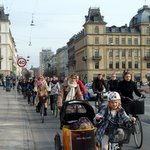
Similar to much of North America, many European countries were affected by the rise of car culture in the 1960s and 1970s, and for more than a decade, they were heading towards the gas pedal rather than the bicycle pedal.

The Dutch and the Danes haven’t always come out of the womb pedaling. Similar to much of North America, both countries were affected by the rise of car culture in the 1960s and 1970s, and for more than a decade, they were heading towards the gas pedal rather than the bicycle pedal. But different from North America, the Netherlands and Denmark both had a history of cycling and indeed, after World War II, the bicycle was the only mode of transport most people could afford. Today, most people there are wealthy enough to afford a car, but large numbers still choose to cycle.
But not all of Europe is a cycling paradise. Far from it. There are any number of places where cycling is next to nonexistent and even some where the number of cyclists has dropped over time. There are also European cities that are making a real effort to develop a culture of cycling where none existed before. This presents a range of lessons to be learned from the good, the used-to-be-good and the up-and-comers.
How Copenhagen Got to Be Copenhagen
As in North America, there was a spirit of protest in the air in Europe in the 1960s and 1970s. In the United States, the protests were not just against racism and the Vietnam War, but also against the destruction of local neighborhoods for the sake of more roads. In New York City, for example, the Lower Manhattan Expressway was stopped by citizen protesters. In San Francisco, the Freeway Revolt prevented several freeways from being built. And in Vancouver, BC, citizens stopped a highway planned to run along the waterfront in the downtown core.
It seems safe to say that if there had been a culture of cycling in North America before the 1960s, activists of the day would have saved it. But that culture didn’t exist. And while many neighborhoods were saved from destruction by passionate citizens, the car still won in the end, claiming the dominant position in the streets of our cities and in the hearts and minds of most of our people.
Copenhagen could have gone the same way. As a symbol of upward social mobility in the 1960s, more and more cars started appearing on the streets. The city was planning for a major influx of cars from such projects as a motorway directly into the city center. Public demonstrations were held against the idea, and – maybe equally important – there was a pragmatic recognition that it was an expensive undertaking and the city didn’t have the money for it.
Although the cry to “get cars out of the city” was getting louder, cycling numbers continued to decline steadily. It wasn’t until the oil crisis in 1973 that things began to change. Gas prices tripled and people couldn’t afford to drive. The gas shortage led to mandatory car-free Sundays. These Sundays reminded people both of the vulnerability that comes from depending on cars and of how much more pleasant walking and cycling are in a car-light environment.
This people-centered as opposed to car-centered attitude took hold. According to Lars Gemzøe of Gehl Architects in Copenhagen, starting sometime around then, “politicians of all stripes could promote themselves by doing the right thing for people on foot or cyclists,” meaning “a stronger policy for cyclists and pedestrians could carry on independent of ideological labels.”
In this way, Bente Frost, a right-leaning lord mayor, could also concurrently serve as president of the European Car-Free Cities movement in the 1990s and Klaus Bondam, a left-leaning deputy mayor for Technical and Environmental Administration in the 2000s, became the “Bicycle Mayor.”
Taking Dallas to Copenhagen
As impressive as it is from a cycling perspective, Copenhagen may not be the most appropriate role model for a North American city just starting out with a cycling plan. Andy Clarke, president of the League of American Bicyclists, said “I wouldn’t take Dallas to Copenhagen to inspire them.” The vast differences between those two cities could easily leave Dallas feeling disheartened rather than inspired. According to Clarke, Seville, Spain, might be a better place for representatives of Dallas to visit. Seville managed to increase its cycling mode share from below one percent to over six percent within five years. While it’s certainly not Copenhagen, Seville’s accomplishments are ones that many North American cities can aspire to within a reasonable timeframe.
Seville and other cities like it achieved dramatic jumps in mode share numbers in a relatively short time, in part through the launch of a large-scale bike share program. Paris took the biking world by storm in 2007 with the introduction of its revolutionary Vélib’ bike share program. The city installed 7,000 bikes at 750 stations. Suddenly there were bikes all over central Paris.
Jörg Thiemann-Linden of the German Institute for Urban Affairs noted that on a recent trip to Paris, he saw parents with kids on bikes in the center of the city, which he said, “would have been completely unheard-of a few years ago.” Paris wasn’t at all bike-friendly before the introduction of Vélib’. Although it still has a long way to go, the dramatic gesture of putting thousands of bicycles in the public eye raised awareness of cycling significantly, and the allocation of public space to bicycles sent a clear message that bikes are welcome on the streets of Paris.
Several other major European cities have introduced comparable programs since then, including Seville, Barcelona, Brussels and London, with London increasing its fleet by nearly 40 percent this past March. None of these cities had a high cycling mode share when they started out. Their bike share programs served as a high-profile marketing tool for cycling – and all the related eco-friendly associations. Montreal, QC, and Washington, DC, have recently had similar successes in North America and New York City is set to jump on the bandwagon this summer with 10,000 bikes of its own.
Indicators of Safety
But simply putting lots of bikes on the streets isn’t enough. Cyclists need to feel safe. John Pucher, a professor at Rutgers University, has written extensively about cycling in North America and in the advanced cycling countries in Europe. He speaks passionately about the different feeling of cycling in the Netherlands versus New Jersey. “In New Jersey,” he lamented, “only 20 percent of drivers stop at crosswalks. There’s no enforcement.” In fact those who are supposed to enforce the law are sometimes the offenders. More than once, Pucher has filed complaints against police officers for endangering him on his bike. The only response he ever received was that the officer in question “didn’t mean to endanger [him].” With such examples, it’s easy to see why risk-averse people – at least in places like New Brunswick, NJ – choose not to ride bikes.
Pucher claimed that women, who are generally more concerned about safety than men, are a good “indicator species” for a healthy cycling environment. As Pucher put it, “When I see a senior woman cycling, my heart jumps for joy!”
But, although they may not admit it, there are still those in North America who don’t really want cycling to be safe enough for their grandmothers. Some “road warriors,” decked out in spandex and on bikes that weigh next to nothing (and have no lights, fenders or racks), enjoy the adrenaline rush of rubbing shoulders with fast-moving cars. The clear message sent by such cycling is that you need to be something special to ride a bike.
In a place where your grandmother could cycle to work (one-handed, with an umbrella in the other), you would no longer get the respectful (or uncomprehending) looks you get from friends and coworkers for riding your bike to work. In such cities – and Amsterdam and Copenhagen are among them – bikes for transportation are functional rather than sporty. The chains are often rusty and the tires half flat, but there are always fenders and a rack or basket, and the lights are built-in and generator-run. Cycling isn’t cool in these places, and it’s not uncool either. It’s just a way to get around. That takes some getting used to.
This Isn’t Difficult
European cities with a tradition of cycling all have separated cycling facilities – although the quality varies greatly depending on how the city developed. Some traditional cycling cities that haven’t kept up with the times have some unexpectedly poor infrastructure. A British cyclist in Bremen, Germany, expressed surprise at the low quality of some of the facilities for a city with such a high mode share (25 percent). But Thiemann-Linden of the German Institute for Urban Affairs explained that some of Germany’s traditional cycling cities have “an archaeological dig of bad bike facility design of the past.”
While many of the traditional cycling cities are now trying to catch up to modern standards, so-called “late starters” have gone in different directions depending on local circumstances. Barcelona and Seville, for example, have built separated 2.5-meter two-way tracks, whereas Berlin and Munich have opted for advisory cycle lanes with no physical separation from car traffic. Both are pragmatic decisions based on space limitations and the local political environment.
But even good separated facilities aren’t rocket science. They are simply the result of establishing and following priorities. Clarke recounted being in Copenhagen with a colleague who was there for the first time. When he asked her what she thought, she said, “I’m just kind of mad.” Puzzled by this reaction, Clarke asked her to explain. “This isn’t difficult,” she said. After all she had heard, she had expected bike lanes paved with gold; instead she didn’t see anything that couldn’t be done in the States.
Taking Copenhagen to New York
And in fact it is being done in the States. Taking a page directly from the book of Copenhagen’s Gehl Architects, New York City’s Department of Transportation Commissioner, Janette Sadik-Khan, has done some radical reorganization of the use of public space in New York. Sadik-Khan invited Jan Gehl himself to New York to advise them on reimagining the city. One highly visible outcome was the reallocation of car space to cycle lanes and pedestrian space along several blocks of Broadway, which has, according to the transportation department, brought about a record jump in cycling, a drop in accident rates for all modes of transportation and an increase in profits for local merchants.
This significant step on the part of New York City was not without opposition, including a lawsuit against the city for one of its new separated bike lanes in Brooklyn. But according to Jörg Thiemann-Linden, such responses are to be expected. He noted that three stages of cycling development can be identified:
1. Bikes as a toy (no political element)
2. Bikes as a traffic safety problem (politically controversial)
3. Bikes as an opportunity (political controversy has, for the most part, been overcome and cycling is part of the standard transportation repertoire)
With these developments, New York is firmly planted in stage two. So too are San Francisco, Vancouver, BC, and Toronto, all of which have experienced significant backlash to separated cycling facilities in recent years.
Sneak Attack
Another bike-related program facing opposition these days is the Safe Routes to School program. Established by the US congress through a transportation bill in 2005, the program is dedicated to making the journey to school safe. The program allocates 70 to 90 percent of the funding to infrastructure in a two-mile (three-kilometer) radius around participating schools, and the remainder goes into education and promotion.
Lauren Marchetti, director of the National Center for Safe Routes to School, described one of their annual events, International Walk to School Day, as a “sneaky event.” They sell it to parents as a one-off, but surveys show that 50 percent of the events lead to follow-up or repeat activities. Often the walk to school helps parents to both reconnect with something they themselves had done as children and to reconnect with their own children. Marchetti noted that these connections are important: “We’re talking about making a cultural shift.”
Safe Routes to School plotted a new sneak attack on the status quo this past spring. In cooperation with the League of American Bicyclists, they sponsored the first ever National Bike to School Day on May 9, 2012.
Despite the program’s success in encouraging active transportation, the most recent congressional election has put SRTS funding in danger. The new congress has a more conservative view on transportation spending, with less emphasis on active transportation.
According to Bernhard Ensink, secretary general of the European Cyclists’ Federation, such a decision by congress would be counterproductive.
He noted that “Cycling needs to be seen as a system. It must be supported consistently, year after year, independent of political parties.” But North America hasn’t yet reached the point where moving people rather than moving cars is the priority. Transportation projects are still often started or called off based on election outcomes.
Opportunity
North America is heading into uncharted waters with respect to developing a cycling culture. While it’s true that the Netherlands and Denmark didn’t always have the high level of cycling they do today, numbers there never reached a point as low as they are in North America now. While we may continue to hold Copenhagen and Amsterdam up as ultimate goals, it may be helpful to look to Seville, London, Kiel and Paris – the parts of Europe without the golden bike lanes – to share ideas about how to get past the stage of “bikes as a traffic safety problem” and move on to “bikes as an opportunity.”
Bonnie Fenton lost a piece of her identity when she moved from Vancouver, BC, to northern Germany, where showing up by bike is nothing special. Since then, she has adapted by getting a Dutch bike for everyday riding and a folding bike for train travel. Fenton now works on cycling and other sustainable transportation projects across Europe. She contributed to Amy Walker’s On Bicycles and recently coauthored a report entitled Promoting Cycling for Everyone as a Daily Transport Mode.
 Winter Bike Fashion in Copenhagen
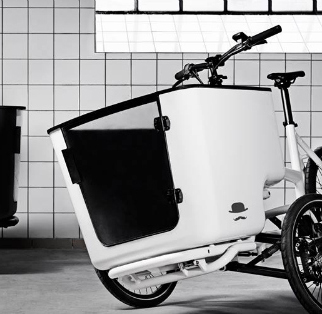 MK1 – Tilt-action Cargo Bike from Butchers & Bicycles
 5 Cities Changing Gears
 Patagonia Women’s Torrentshell Rain Pants Review
 How to Dress for a Hot Summer by Bike
 Osprey Spin 22 Backpack Review
 Cozy Comforts
 Europe’s best spring cycling destinations for nature-loving bicyclists
Find inspiration in our Gear Guide that will keep you out on your bike through wind or rain.
Download Now


I’m a bicyclist, not a biker. Or just a guy on a bicycle. But I’m not a biker.
” But different from North America, the Netherlands and Denmark both had a history of cycling and indeed, after World War II, the bicycle was the only mode of transport most people could afford. ”
Wrong! North America absolutely did have a history of cycling. Look at this image of Rochester, New York, from 1904. http://i.imgur.com/7J4dM.jpg
Zoom in to see many bicycles locked to bike racks, the sides of buildings, and street poles. I count at least 15; some faster cyclists may be missing from the picture because of the long exposure time.
The modern view for comparison: http://goo.gl/maps/JMpSS
Rochester is now as car-dominated and transitless as most small American cities, but clearly at one time had a strong, practical cycling culture.
Now that the automobile is the only viable transportation option in most of America, I can certainly understand why one would assume it had always been this way, but it’s inaccurate writing. I wish articles like this would stop perpetuating this falsehood. The dominance of the car is a recent change, and only now that the bicycle has been completely marginalized does it seem like it was never an option. It’s not that we never had a cycling culture, it’s that our cycling culture was destroyed.
Comments are closed.